Design Is Not a Democratic Process
Design Is Not a Democratic Process
Why the best products are never designed by committee.
5 min read
The confusion
A misunderstanding keeps showing up in boardrooms and product meetings. It sounds reasonable. It feels inclusive. And it quietly destroys great products.
The idea that design should be democratic.
Let me be direct: design is not a democratic process. The brands that understand this produce work that lasts. The ones that don't produce work that disappears.
Democracy belongs in adoption, not creation
Design should create products that work for everyone. Intuitive, clear, desirable. That's democratization of use. That matters deeply.
But the process of getting there demands the opposite of consensus. It demands judgment.
Great design feeds on broad inputs. Customer research, engineering constraints, market context, business strategy. All of it sharpens the work. The wider the perspective, the better.
The problem starts when those inputs get equal voting rights.
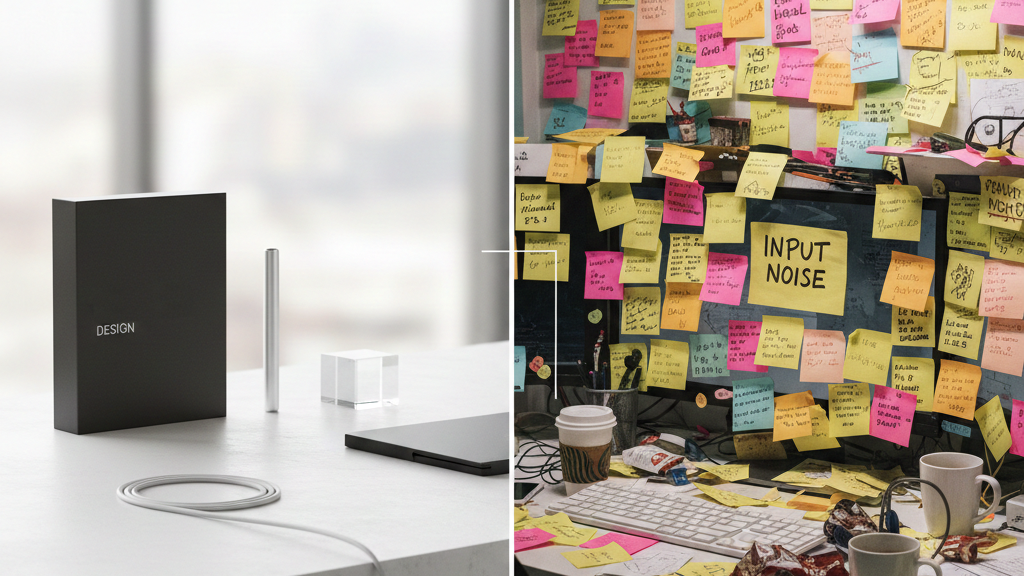
What happens when design becomes a vote
Every stakeholder gets a say. Every opinion carries the same weight. Features pile up to satisfy the room. Edges soften so nobody objects. The product becomes a compromise rather than a decision.
The idea gets all watered down and transparent.
You end up with something no one hates. Which means you end up with something no one loves.
This is how premium brands lose their edge. Not through one bad call. Through a thousand small surrenders to consensus.
The role of the designer
A great designer doesn't ignore input. A great designer prioritizes it. Hears everything. Then decides what stays and what goes. That's the craft. Not addition. Subtraction.
Reduction demands judgment. It demands someone willing to say, "This doesn't belong here." Not because it's bad. Because it's not essential.
That's not arrogance. That's responsibility.
The best products in the world, the ones people reach for without thinking, the ones that age well, the ones that define entire categories, never came from a committee. They came from professionals who listened broadly and edited ruthlessly.
What this means for your brand
If you lead a premium brand, people have told you to involve more voices in design decisions. Shared ownership. Risk reduction. It sounds smart.
The real risk is dilution.
The brands that maintain clarity over decades protect the design process. They find the right designer. They give them the full picture. Then they trust the judgment they hired.
That doesn't remove people from the conversation. It respects the difference between input and decision.
The principle
Broaden the inputs. Narrow the decision-making.
Design is not a vote. It's a discipline.
-