Not using AI is expensive
If you lead a product team or a brand in 2026 and you aren't using AI for research, iteration, and exploring directions, you're losing money every week. Your competitor looks at forty options while you look at four. I run an industrial design studio, and I watch this happen. Most of my profession is afraid of it.
I'm not. I use it every day, and I've lost my own hours down rabbit holes that looked interesting, so I know the pull from the inside.
There is a second cost, and it's growing faster than the first. Nobody treats it as a problem because it looks like productivity.
Ten directions, no story
A team generates ten product directions in a week. All ten look finished: realistic proportions, CMF boards, a deck that impresses everyone. Then the team sits in the review and can't choose, because there's nothing to choose between. Every option answers the question "what could this look like?" Nobody in the room can say why this product exists and why it matters.
Today, the expensive product is the one that ships and means nothing. In the worst case, it damages the brand on the way out.
Renderings are cheap now. Options are cheap. Features are cheap, and your competitor copies them within one cycle.
What still costs money, and still earns it, is a product that carries a story the customer feels before reading a word. The material matches the brand's promise. The gap between two parts shows what the company thinks about precision. The weight in the hand says this was built to stay. A product like that stops competing on features and price. Everything else competes on features and price, and loses on both, because someone is always faster and cheaper.
AI multiplied a problem that already existed. A team that used to produce three shallow concepts a quarter now produces thirty. The shallowness came along. Speed scales whatever you feed it.
Nobody looked
You saw the extreme version in May 2026. Starbucks Korea launched an AI-generated "Tank Day" promotion on the anniversary of the Gwangju uprising, with a second slogan that echoed a 1987 torture death. Seven people approved it. Several of them, by their own account, never opened the design file attached to the email. The CEO was dismissed. The parent group's chairman bowed in apology on live television. The defense ministry suspended its partnership with the company.
Everyone reads this as an AI failure. The AI produced a plausible option at high speed, which is its job. Seven humans had the chance to look, and nobody looked, because the process had been rebuilt around speed and looking was no longer anyone's job. Remember that mechanism. It kills products too, slower and without the headlines.
The numbers did not add up
My own version is on the product side, where the cost sits in tooling and calendars.
A client wanted to move fast. AI had generated most of the documents. I read them with AI assistance too; that's not the issue. Then I took them apart. The connections didn't hold. The numbers didn't add up, and neither did the brief.
The lead time was the first sign. In a normal year, it might have worked. With the current geopolitical situation, you can't cut and ship tooling in that timeframe. A model doesn't know that. It gives you the average of everything it has read, so it gives you an average answer. I know the difference because I did a polymechanic apprenticeship and worked in manufacturing before I studied and did a master's in design. I've stood next to the machines that cut these tools.
The second gap was bigger. The brief had features, specs, and a price point. It had no story. Nothing about the community around the brand, nothing about why this product and why now. In a saturated market, that's a product failing before it exists.
We postponed. The client didn't love it in the moment. Launching would have burned the tooling budget on a product that arrived late with nothing to say. The pause was definitely the cheap option.
Write the launch story before you build
Here is what we do about it, and you can copy it.
The brief comes in. We do the research, the user work, and the market work, then we sit down with everything on the table and turn it into one document: a fictional press release, written for the internal team and the client. The launch announcement for a product that doesn't exist yet, written as if it had already shipped and worked.
Who is holding it? What problem does it solve in their life? What do they tell a friend about it? What does the material say before anyone reads a spec? How did the market react?
The constraints are the point.
One page, one and a half at most. If the story needs more room, the product isn't clear yet.
Three or four features. If a line doesn't earn a mention in the release, the team doesn't build it. That one rule cuts more waste than any review process I've seen, because it moves the scope discussion to week two instead of after tooling.
A person writes it in plain language, the way they'd describe the thing at a dinner table. If it only works in specification language, nobody outside the room will ever feel it.
If nobody on the team can write that page, there is no product yet. A feature list is waiting for tooling money.
Once the page exists, every decision afterward is held against it: the core problem, the target user, the required experience. Engineering choices, material choices, cost factors, and the forty AI directions all pass through the same filter. The question changes from "which one looks best" to "which one keeps the promise".
That is what turns speed into an advantage. The AI can generate as much as it wants because the team knows what it's looking for. A team choosing between renderings takes weeks. A team checking renderings against a promise takes an afternoon.
It's also how a brand stays consistent. Consistency is a promise made and kept across every product, every material, and every gap. The press release is where someone writes the promise down before the speed starts.
Everything the machine has is the past
An AI model works from what has already happened. Every option it gives you is a recombination of existing elements. That's what it is, and it's why it's so good at the analytical part: research, structure, variation, checking, sorting. All faster than any team you could hire.
Designers work in the other direction. Engineers optimize what exists, and that work is essential. Designers work toward something that hasn't happened yet: a need nobody has articulated, a behavior that's only starting, a product a person doesn't know they want because there is nothing yet to want. You can't average your way there. There's no data on a future that hasn't arrived.
So when a designer says "this is the direction" and can't yet prove it, that is the job.
The whisper
In every project there's a moment where the thing that matters doesn't shout.
It's small. A proportion that shouldn't work and does. The sound when a lid closes. The way light moves across one surface and dies on another. A behaviour that changes how the product is used.
Nobody put it in the brief, and nobody asked for it, and once it's there the product makes people stop, and they can't tell you why, and they buy it.
It comes from everywhere and never on schedule. While I am sketching, milling, holding a rough part. From what a client says, and more often from what a client doesn't say: the silence in a brief, the thing they never asked for because they don't know it's possible. And from users, from what they do rather than what they say. They tell you the handle is fine, and then their thumb keeps landing two centimeters from where you put it. Their hand knows something their sentence doesn't.
That's the signal from the future, pointing backward. It hasn't happened yet, so it isn't in the data. It arrives as a detail, and a person has to be in the room to catch it.
A machine will generate a thousand gaps and stay silent about which one means something, because meaning isn't a frequency in a dataset.
The asymmetry nobody fixes
Underneath all of this is a structural problem older than AI.
Creative people present their ideas to rational people for approval. It never runs the other way. No accountant walks into a design studio to have intuition approve a spreadsheet. The rational side holds the veto; the creative side holds suggestions.
So the safe option wins by default, because it survives the room. And AI handed the rational side a much bigger gun. Every safe option now comes with forty variants and a benchmark analysis. The whisper comes from one person saying, "I believe this is the one."
That person loses the argument every time, and the room isn't wrong to want proof. Numbers make a buyer feel safe, and that feeling is what lets someone sign a budget. The problem is that only one side can bring proof. So bring proof for the other side.
Give the whisper a body
This is why we never present a concept on a screen alone.
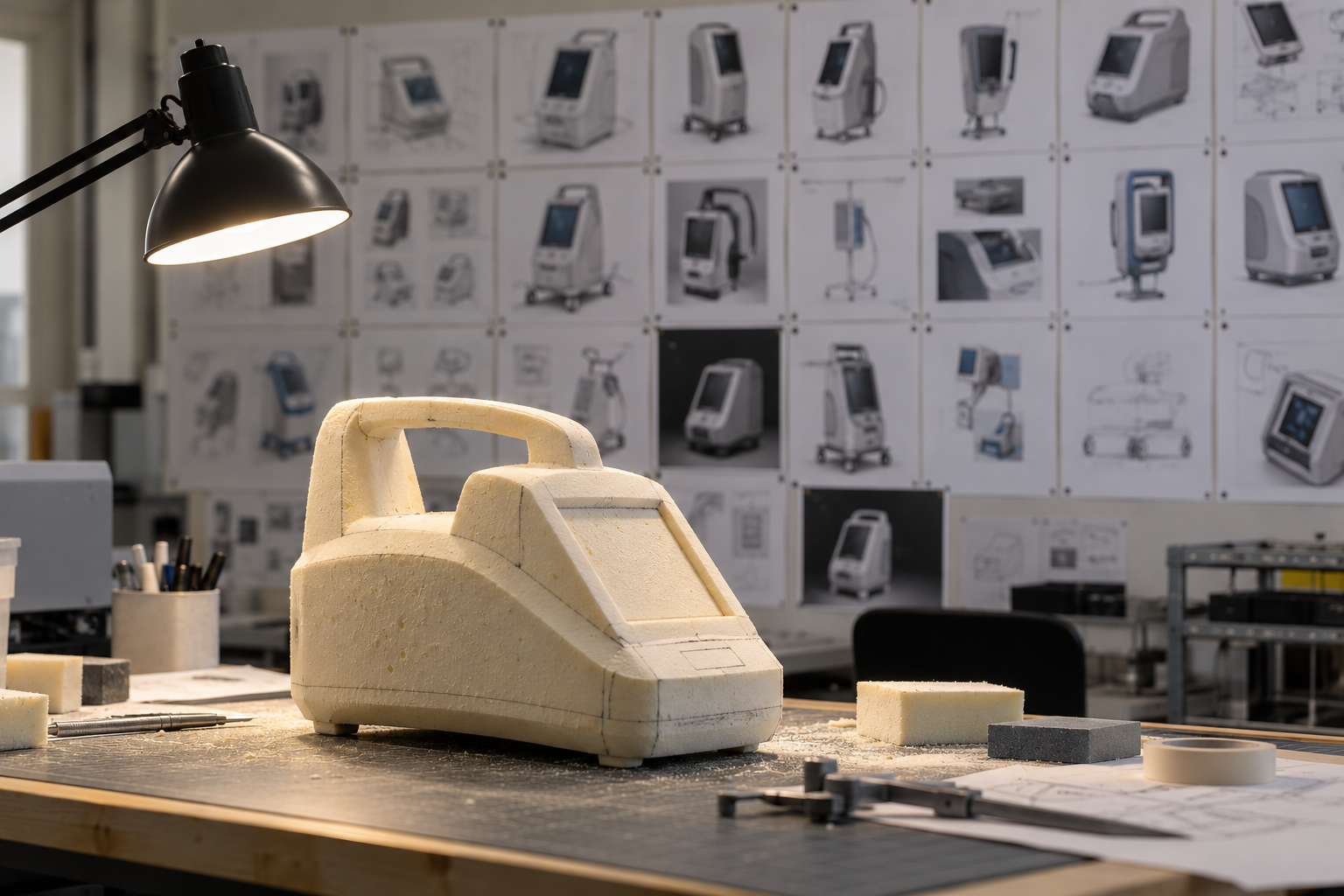
Every review has something on the table. Early on, it's rough and grey and in the wrong material, on purpose. A rough model shows proportion and scale, and we can test it. As the risk goes up, the prototypes get closer to the final product: low-risk mockups first, high-risk prototypes before anyone commits. In between, we use VR and AR to put the concept in its real context at real scale. We've worked this way with JURA and Wetrok, and on a car concept where VR was the only way to judge whether the proportions held when you stood in front of it. You can't print a car in week two.
Two things happen when the object is on the table.
The whisper becomes evidence. An idea that lived in one person's head becomes something eight people can hold, and now it carries the same weight as the spreadsheet. Everyone in the room can check it themselves. The safe choice stays available. It just stops winning by default.
And the moment of truth moves. Most teams find out whether the story holds at launch, after they've paid for the tooling and filled the warehouse. We find out at the prototype stage, with real users holding the thing, watching what their hands do before listening to what they say. The rest of the process runs at full speed. We find the failure where it costs hundreds instead of hundreds of thousands.
There's a saying in the military: slow is smooth, smooth is fast. It sounds like a contradiction until you've watched a rushed project eat its own timeline twice. The press release before the sprint, the rough model on the table, the user holding the prototype before tooling: that's the slow part, and it takes days, not months. Teams that skip it arrive early at their own expensive mistakes.
Monday
Two rules. You can install both in a week.
No product work starts without the internal press release. One page, three or four features. If nobody can write down why this exists, the speed has nothing to run toward.
No concept is presented on a screen alone. Every review includes something physical; rough is fine, and real users touch a prototype before the team cuts tooling. Watch their hands, not their answers.
Use the speed, all of it. The AI only knows what has already happened, and the thing that will make your product matter hasn't happened yet. Put it on the table so everyone can hear it.