The design process does not work.
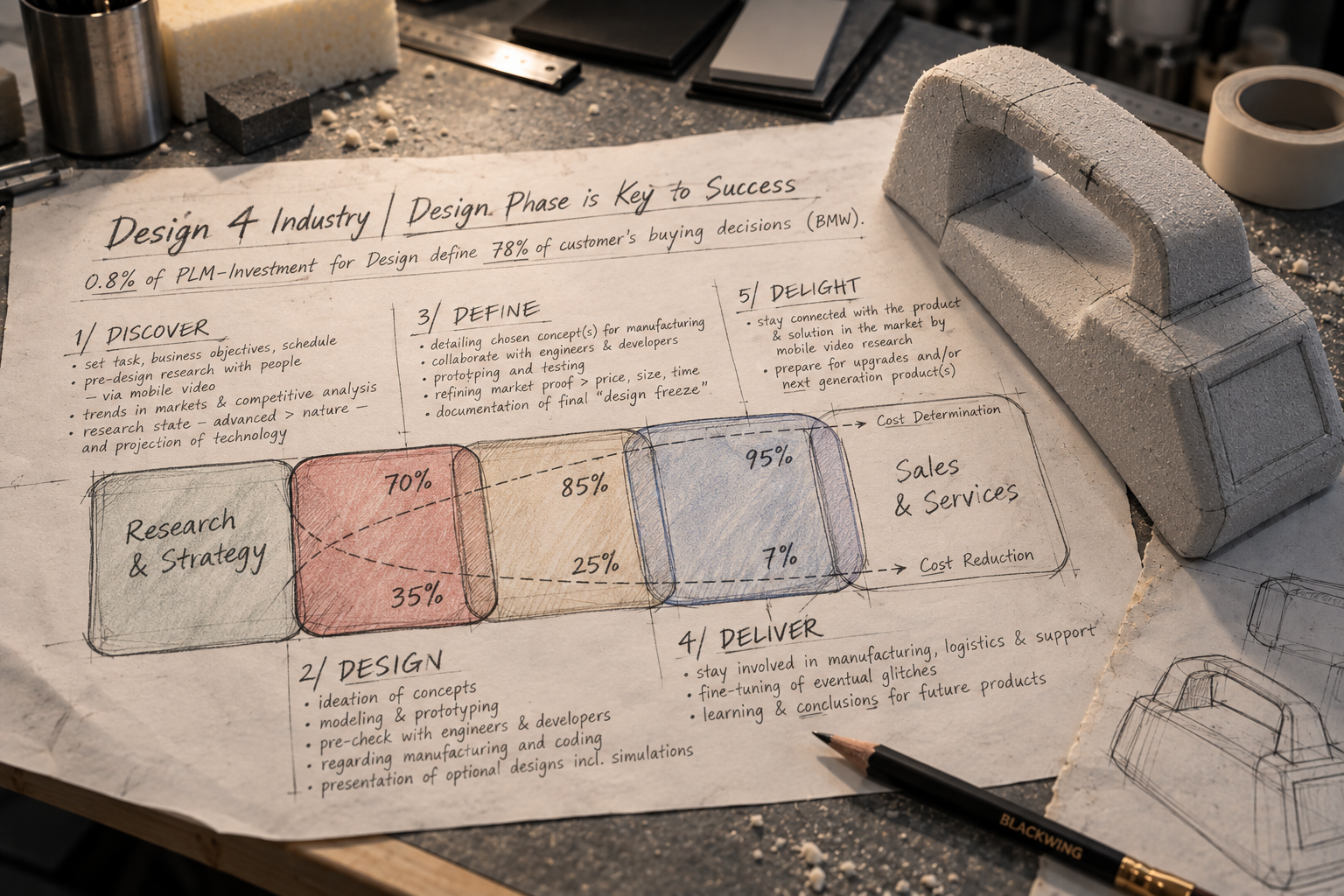
Every design studio can show you its process. Phases, diamonds, gates, arrows that flow left to right and end in success.
Mine included. I showed that diagram in pitches and saw the room relax. A process looks like the manufacturing logic that every industrial company already trusts. Input, method, output. Predictable, repeatable, safe to buy.
Here is what two decades of running projects have taught me, and my own profession will not thank me for saying it: the diagram is true, and the promise is not.
The diagram is true, and the promise is not.
The process works, in the sense that it reliably produces a competent product. Research gets done, directions get explored, decisions get documented, the thing gets built, and it functions. Makers create the product, and it works. Competence is real value, and I am not sneering at it. Competence is the eighty percent. That is what everyone else's process delivers too. This is why many well-run projects create products that work well but matter to no one.
The twenty percent that makes a product matter, the detail people cannot explain but pay for, has never once arrived where the diagram said it would. Not in my projects, not in twenty years. It arrives while holding a rough part, when the weight is wrong in a way that suddenly explains what the product wants to be. It arrives when a user tells you the handle is fine, but their thumb keeps landing somewhere else, and their hand disagrees with their sentence. It arrives from what a client did not say in a briefing, the silence around the thing they never asked for because they do not know it is possible.
None of us scheduled those moments. All of them happened outside the phase we were officially in. And every product I am genuinely proud of exists because of one of them, not because of the process that surrounded it. That idea and little hint whispers, never shouts. And it is incredibly delicate and requires care.
So the honest description of a design process is this: it cannot manufacture the moment that matters. If built for it, it can make the moment likely and ensure that someone catches it. Enough making early, so there are rough parts to hold. Enough contact with real users so hands have a chance to disagree with sentences. Enough room in the plan that an unscheduled discovery is a gift and not a derailment. The process is not the machine that creates the insight. It is the net that catches it. Most processes I see are like machines: tight, efficient, and closed. That is how the twenty percent slips by unnoticed.
The process is not the machine that creates the insight. It is the net that catches it.
This changes what you should buy if you buy design. A deliverable is the eighty percent. Any competent studio can promise this. Now, with AI, the eighty percent is faster and cheaper than it has ever been, ...which quietly makes it worth less than it has ever been. What you are actually paying for is the other thing: that when the detail that would make your product matter shows up, unannounced, in the wrong meeting, somebody in the room recognizes it and has the standing to fight for it.
The diagram will not tell you whether that person exists. Ask instead what a studio caught that was not in anyone's plan, on a real project, and what it changed. The answer to that question is the studio.
Ask instead what a studio caught that was not in anyone's plan.
The process is scaffolding. Nobody has ever loved a building for its scaffolding, and nobody has ever bought a product because the diagram behind it flows left to right.
If you want to know what we caught on a real project that was not in anyone's plan, ask.
Talk to Roberto. Thirty minutes, no slides. Book a slot or call +41 44 521 03 93.
Roberto Inderbitzin runs REFRAME Design, an industrial design and strategy studio in Zürich, design partner to JURA and Wetrok. He hosts the podcast Conversations with Roberto.